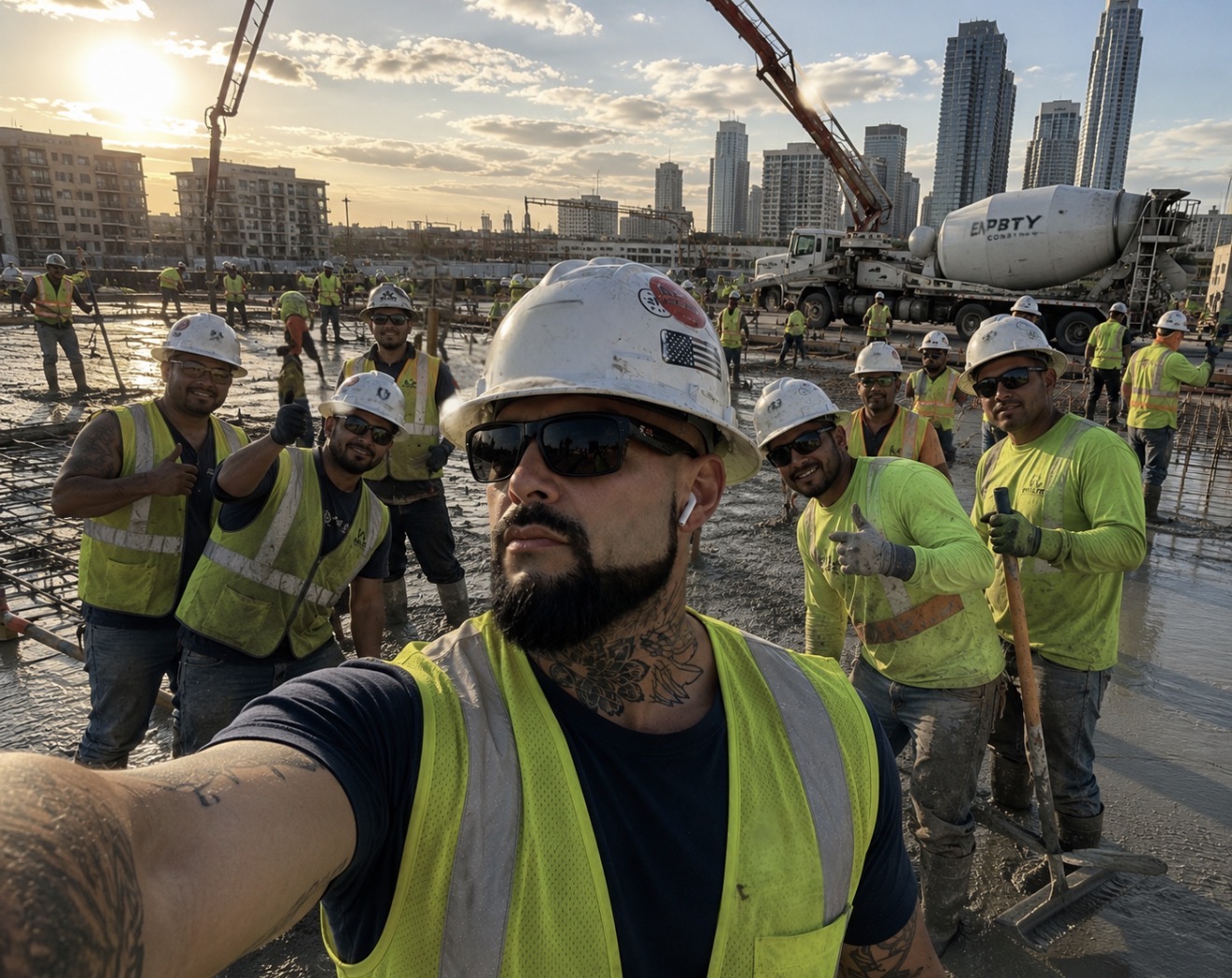
From Laborer to Estimator: What 30 Years in Concrete Taught Me About Leadership

You cannot lead a crew you would not have wanted to work for. Everything else — schedule, budget, safety — flows from that.
In 1993 I was a laborer on a union crew in Miami. My job was to keep the finishers happy, keep the placement crew moving, and stay out of the way of the men who knew what they were doing. Nobody was writing articles about leadership on that jobsite. But every day, I was watching how leaders actually behave when nobody is filming, and I didn't know it yet, but that was the whole education.
The path from there followed the pattern this trade has run for generations, and it still runs today — laborer to apprentice, apprentice to journeyman, journeyman to foreman, foreman to superintendent, superintendent to general superintendent, and for some of us, general superintendent into the office as a project manager or estimator. Every rung on that ladder asks for something the last one didn't. The jump from tradesperson to foreman asks you to start caring about other people's work, not just your own hands. The jump from foreman to superintendent asks you to start owning the schedule and the budget, not just the crew in front of you. The jump into the office asks you to translate everything you know about how concrete actually gets placed into a number, a contract, and a conversation with an owner who's never been on a jobsite in his life.
The good foremen I came up under did three things, and I've never found a fourth thing that matters more. They showed up early. They knew every man by name and knew what he was going through outside the gate, not just what he did inside it. And they never asked anyone to do anything they hadn't done themselves. That was it. The bad foremen were loud, they were absent when it mattered, and they blamed the crew when the work went sideways instead of asking what they, as the leader, had failed to set up correctly.
Thirty years later, running crews of thirty-plus on high-rise concrete projects across Miami, I never really left that lesson behind. The scale changed. The complexity changed. The paperwork changed enormously. But the fundamentals of leading people who work with their hands and their backs did not change at all, and I don't think they ever will, no matter how much technology reaches the jobsite.
What the research on this career path gets right is something I felt long before I could have articulated it: a superintendent's job teaches responsibility, coordination, and accountability at a scale that very few other jobs hand a person, especially a person who started with a shovel. You are simultaneously responsible for thirty people's safety, a schedule that has real financial penalties attached to it, an owner who wants updates in language he can understand, and a physical product that either holds up for fifty years or doesn't. Very few 25-year-olds get handed that much real responsibility anywhere else in the economy. It ages you fast, and it teaches you fast, if you let it.
The single most underrated leadership skill in construction is being calm on a bad day, and concrete construction gives you plenty of bad days to prove it. A late truck. A pump that goes down. A weather cell that shows up an hour early. If the superintendent panics, the crew panics, and panic on a live pour is how mistakes get made. If the superintendent walks the deck, looks at the actual problem instead of the imagined one, makes three clear decisions, and communicates them without raising his voice, the crew executes. Every single time. I've watched it fail the other way too many times to believe otherwise.
Moving from the field into estimating and project management in 2023 was its own kind of humbling. I had thirty years of field judgment and exactly zero years of formal cost-forecasting experience. What got me through it was refusing to let go of the field instinct — I built my bids from real production data instead of a database, because that was the only asset I actually owned that a fresh MBA with a Bluebeam license didn't. That combination, field-tested judgment paired with office-level discipline, is rarer than either skill on its own, and it's the whole reason I think this industry needs more people willing to make that jump both ways instead of staying in one lane their whole career.
Leadership in this trade is a physical practice before it's ever a philosophy. It is where you stand on the deck. It is how you talk to the finisher who's on his fourth twelve-hour day in a row. It is whether you go to bat for your guys when the GC wants to shave overtime off the schedule to protect his own number. It is not a slide deck, and it never will be. It's the daily decision to be the kind of superintendent you would have wanted to work for back when you were the twenty-two-year-old laborer just trying to stay out of everybody's way.